Peace Talks and Price Gaps: Why Europe is Diving While Asia Holds Firm #ChartOfTheDay
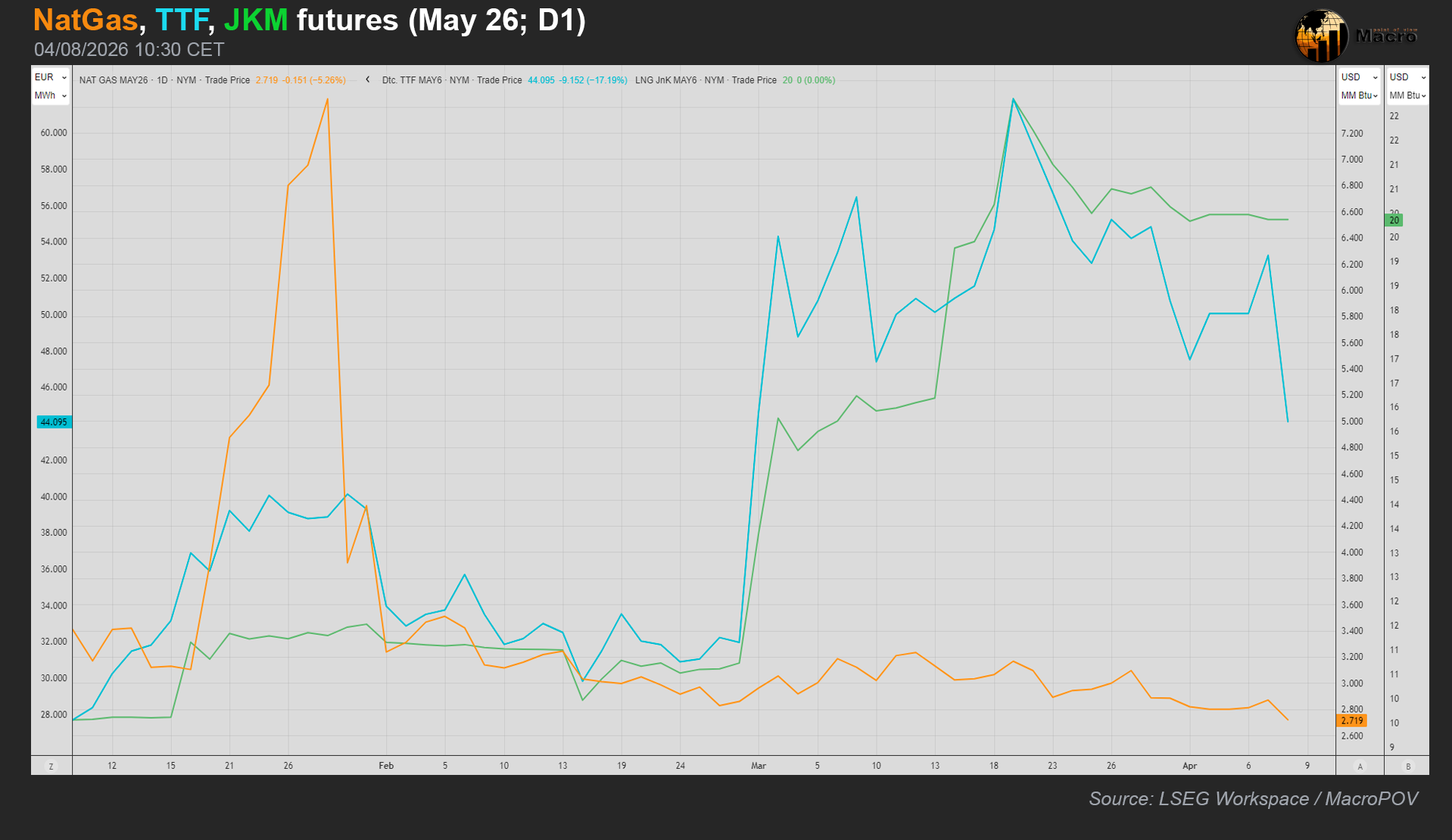
The energy landscape shifted significantly this morning. As news of a two-week ceasefire between the USA/Israel and Iran hit the wires, the reaction across the three major global gas hubs: NatGas (US), TTF (EU) and JKM (Asia) revealed a fascinating regional split in sentiment.
The European Lead
The Dutch TTF (blue line) has entered a steep descent. The European market, historically the most sensitive to geopolitical friction, is currently pricing in the de-escalation with far more vigor than its counterparts. This “volatility of hope” suggests that the EU risk premium was heavily tied to the immediate threat of supply disruptions that the ceasefire temporarily alleviates.
Asia’s Caution vs. US Infrastructure Bottlenecks
In contrast, the JKM (green line) shows a much flatter trajectory. Asia remains cautious, likely focusing on long-term structural demand rather than short-term geopolitical headlines.
Meanwhile, US Henry Hub prices (orange line) continue to hover at the lower end of the spectrum. Despite the global fluctuations, the United States is currently operating at its “physical ceiling.” Every cubic foot of LNG that can be liquefied and loaded onto a ship is already being exported. Until new export terminals come online, the US remains a high-volume, low-price island, unable to further bridge the gap between domestic supply and global demand.
Conclusion: Europe is winning the “optimism race” for now, but the widening spread between TTF and JKM will be the key metric to watch as the ceasefire deadline approaches.