The Iran War Has Begun: Oil, Logistics, and Global Escalation
The war in Iran has begun. As predicted following the conclusion of the Olympic Games, a preemptive strike by Israel and the United States has transitioned from a possibility to a brutal reality.
According to the Iranian news agency Fars, retaliatory strikes have already targeted US bases in Kuwait, Bahrain, Iraq, Qatar, and the UAE. We are also seeing missile interceptions over Jordan and explosions in Syria and Tel Aviv.
This is not a repeat of the swift American success in Venezuela; the “Twelve-Day War” of June 2025 suggests that this escalation will not be extinguished in a matter of hours. With the Supreme Leader Ayatollah Ali Khamenei reportedly absent from his targeted compound during the initial strikes, the stage is set for a prolonged conventional conflict.
In a region responsible for a massive share of global oil and LNG production, the risks are inherent. Today, I want to examine two extreme market and geopolitical scenarios.
1. The Chokehold: Hormuz and the Red Sea
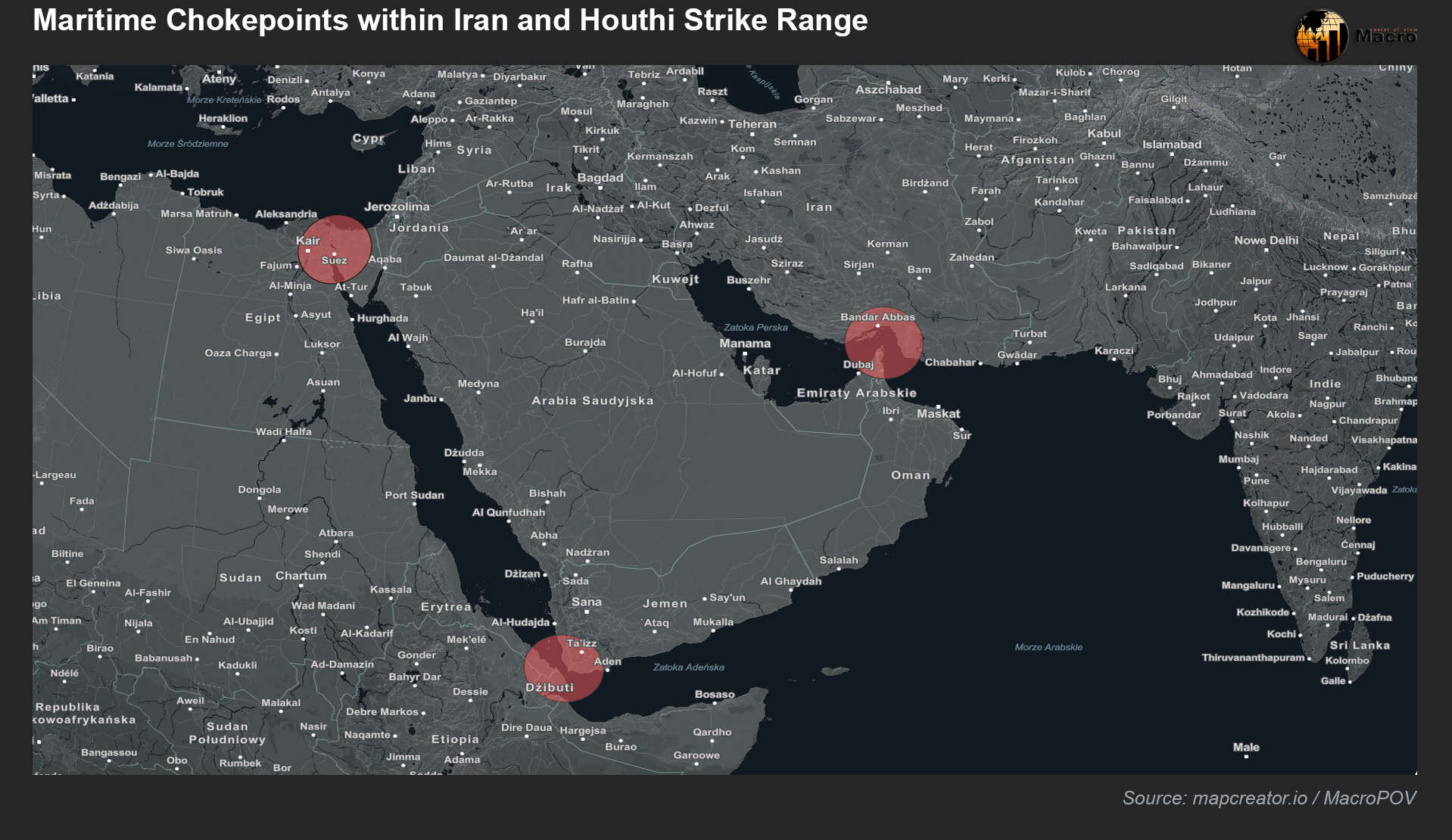
The Strait of Hormuz and the Red Sea represent the most critical maritime logistics artery for Asia and Europe.
- The Energy Pulse: Approximately 20% of the world’s oil and 20% of its Liquefied Natural Gas (LNG) flows through the Strait of Hormuz.
- The Supply Shock: While 2026 forecasts initially pointed toward a market oversupply, the threat of a blockade—physical or risk-based—instantly eliminates those surpluses.
- Price Projections: A disruption lasting just 2-3 weeks could trigger an avalanche in pricing, with oil and LNG costs potentially surging 40% to 50% above February 27th levels.
The Houthi rebels in Yemen further complicate this by dominating trade in the Red Sea. Rerouting ships around the Cape of Good Hope adds an expensive 5-7 or even 10 days to every journey.
The Extreme Scenario: Iran may attempt to force a ceasefire by fully blocking Hormuz or deliberately sinking a vessel in the Suez Canal. Given that the Suez handles ~12% of global trade, a sunken ship would be far more difficult and time-consuming to clear than the Ever Given grounding of 2021.
2. The “China Factor” and the Risk of World War III
The geopolitical stakes involve more than just regional players. In February 2026, Iran, China, and Russia conducted their “Maritime Security Belt 2026” exercises, marking their seventh joint maneuver since 2019.
China’s interests in the region are existential:
- Refinery Dependence: Chinese refineries are specifically calibrated for heavy and ultra-heavy crude varieties from Iran and Venezuela.
- Supply Scarcity: Following the capture of President Maduro by US forces in January 2026, China’s options are dwindling. Alternatives like Canadian WCS or Mexican Maya are either geographically difficult or already claimed by the US market.
The “Black Swan” Event: The true danger lies in the fog of war. In an era of intense electronic warfare and signal jamming, the possibility of a US missile “accidentally” striking a Chinese vessel—such as the advanced Liaowang-1 currently in the region—is no longer statistically improbable.
Under the current administration, such an incident could easily bypass diplomatic cooling and ignite an open armed conflict between the world’s two largest economies. This would be a definitive “game changer,” potentially escalating into World War III. In such a world, gold prices would adopt a trajectory previously reserved for cryptocurrencies: to the moon.
We are entering a period of unprecedented volatility. The consequences of this alignment of events are almost too tragic to imagine.
P.S. These are the final days to vote in the Invest Cuffs 2026 competition. I am honored to be nominated in the Analyst and Influencer categories. You can cast your 👉 vote here (link)
Find “Bogusz Kasowski” in “Analityk” and “Influencer” categories and select
Fill in “Twoje dane” (Your details) at the bottom.
Imię = First Name | Nazwisko = Last Name | E-mail = Email.
Check the first box and click “WYŚLIJ” (Submit). Thank you!